
Marine Planning Options
Planning for Barbados’ Ocean Future
Barbados is developing a Marine Spatial Plan to guide how our ocean space is used, protected, and managed, now and for generations to come. With many activities taking place at sea, from fishing and tourism to conservation, research, and shipping, careful planning is essential to balance environmental protection with sustainable economic and social development.
This plan is being shaped by scientific research and meaningful engagement with stakeholders who use and depend on the marine environment. By combining data on marine ecosystems with knowledge from ocean users and communities, we are working to ensure that decisions about our marine space are practical, inclusive, and grounded in evidence.
As a key step in this process, we have developed draft marine management options, also known as scenarios. These draft scenarios explore different ways Barbados could organise its marine space to meet national goals, including the Blue Bond’s conservation targets, while supporting livelihoods, food security, and cultural connections to the sea.
The Options
The draft marine management options are spatial representations showing different ways Barbados could organise and manage its marine space to meet the Blue Bond’s conservation targets while supporting sustainable economic and social development now and into the future. Each option is presented as a map that indicates how strongly marine laws and regulations would apply in different areas. Under each option, marine areas fall into one of two categories:
- Areas prioritised for strong, non-extractive conservation; or
- Areas managed for sustainable, multi-use activities.
Each scenario combines these approaches differently, offering four plausible futures for Barbados’ Exclusive Economic Zone. They are not fixed choices, but planning tools to help show how decisions about conservation areas can shape development, protection, and enforcement across the ocean space that supports our food, jobs, and culture.
While each scenario is shown as a map, the underlying data go further. It identifies the environmental assets (seafloor features) being protected, the activities (fishing, water sports, research among other things) and protected measures supported by Government, and their precise locations at sea. Communicating what these classifications mean both for environmental protection and for people’s livelihoods is essential. The scenarios were developed using scientific evidence, stakeholder engagement, and a structured technical process.
How the scenarios were developed
These scenarios are based on solid science and broad public input. They were developed through several connected steps:
1. Understanding what is happening now:
Information about marine habitats, ocean conditions, and how people use the sea, such as fishing, tourism, shipping, and energy was brought together in one shared mapping system. This helped show where activities already take place, where opportunities exist, and where more information was needed.
2. Listening to people who use the ocean:
Fishers, tourism operators, scientists, conservation groups, government agencies, and members of the public shared their knowledge through surveys, interviews, mapping exercises, and consultations. More than 1,500 people helped map how the
ocean is used, with hundreds more contributing through interviews and focused assessments.
3. Analysing the information:
The team created maps showing where important marine habitats are located and where human activities are most intense. By looking at these together, we were able to identify areas rich in marine life that have low conflict with current uses, as well as sensitive areas that need stronger protection due to heavy pressure.
4. Exploring future possibilities:
In February 2025, the Project Steering Committee examined different ways ocean management could evolve in the future. They focused on two key questions: how strong ocean rules might be, and whether ocean use would focus more on conservation or
extraction. This led to four possible future scenarios, each showing how pressures on the ocean could change over time.
5. Designing conservation areas:
Using all of this information, conservation experts and mapping specialists suggested possible protected areas in both coastal and deep-sea waters. These draft areas are now being shared so that stakeholders and the public can help shape final, widely supported conservation zones.
Why we are sharing these drafts
We are sharing these draft scenarios to:
- Show how the Marine Spatial Planning (MSP) process brings together scientific data and public input to design marine conservation areas.
- Invite people to compare different conservation options for Barbados’ ocean space and highlight their possible benefits and risks.
It is important to note that these scenarios are not final decisions. They are tools for discussion. They reflect our best understanding so far, based on the information collected to date.
Option 1
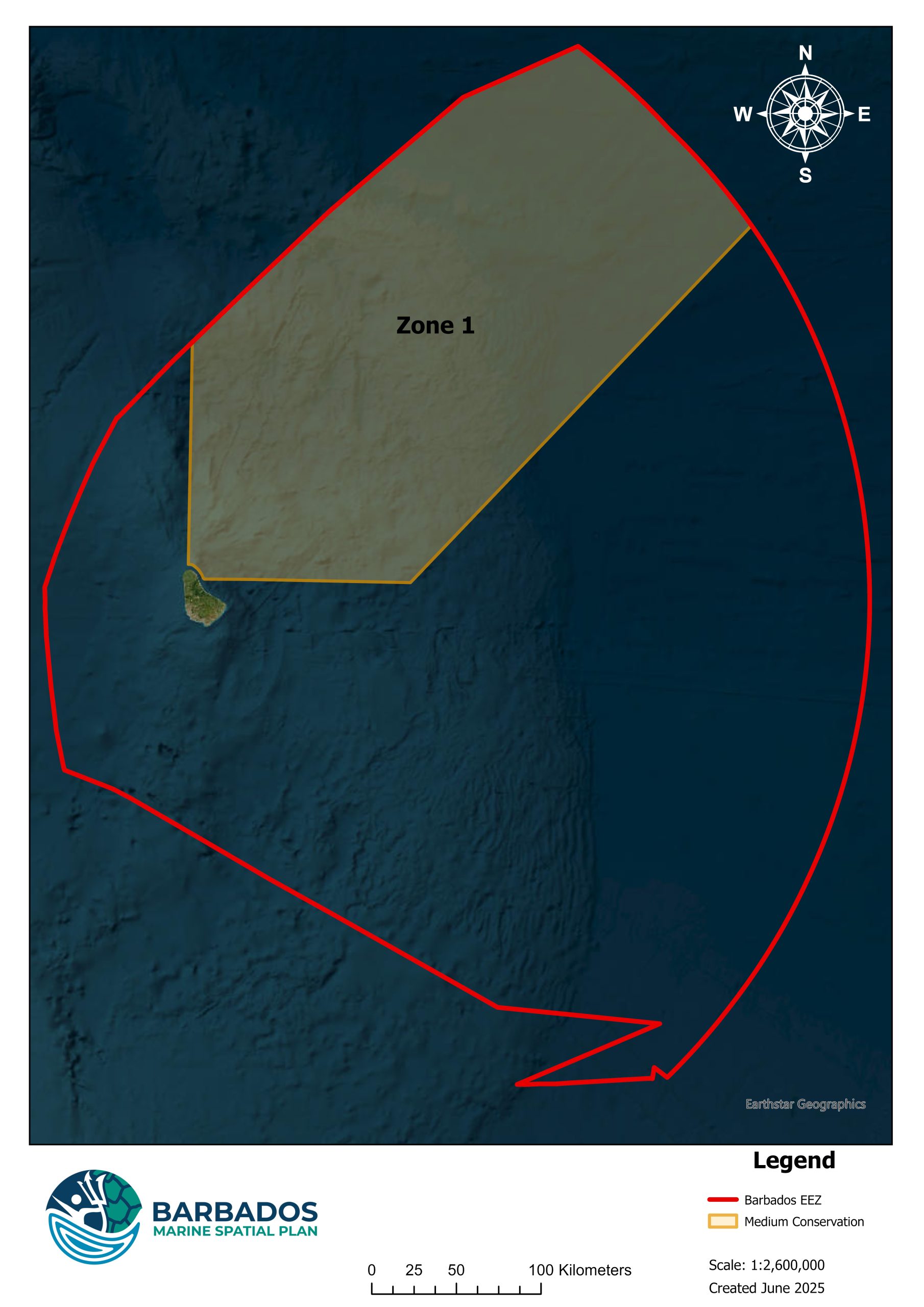
“Tempest Tides” is designed to significantly strengthen biodiversity protection across Barbados’ marine space, with a strong focus on offshore ecosystems, accounting for 30.75% of the Exclusive Economic Zone. In this scenario, there is a very small area of high protection nearshore while most of the protected area is allocated to medium protection in the deep-sea.
Option 2
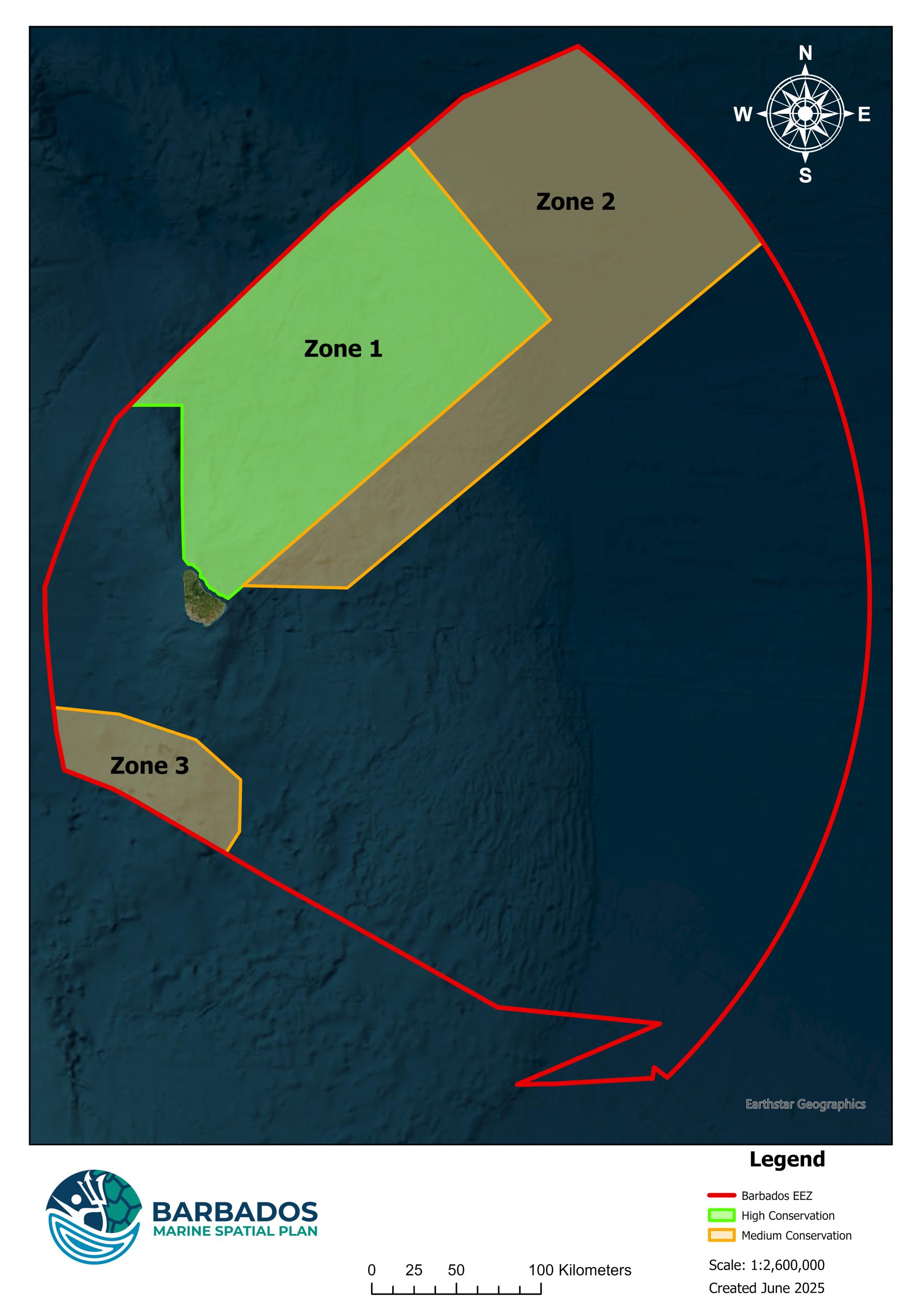
“Drifting Currents” delivers the highest overall level of biodiversity protection across 33.28% of Barbados’ marine space with a balanced and elevated use of protected areas with high protection zones in the deep sea, and medium protection in the south-west.
Option 3
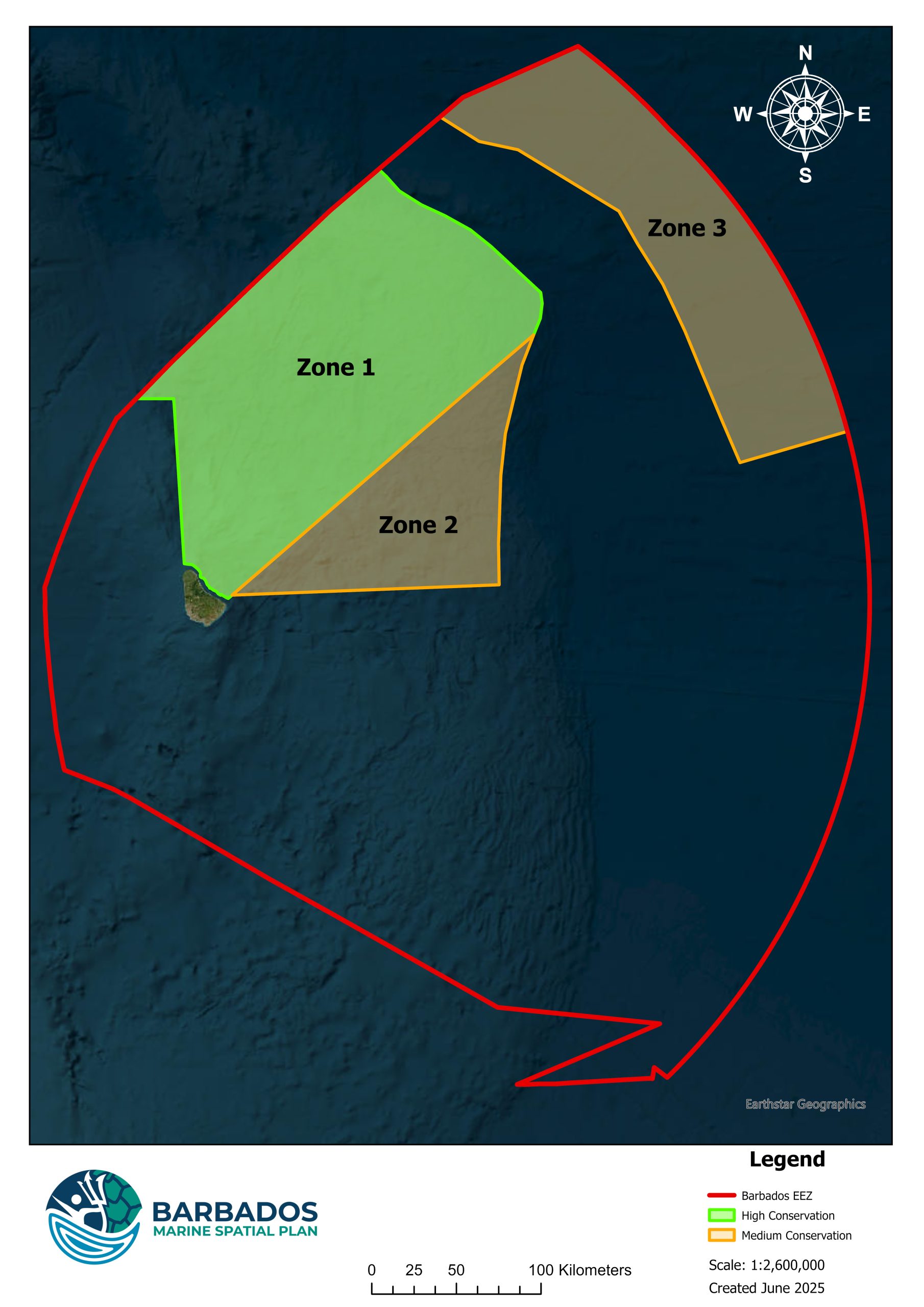
“Rogue Waves” provides a more targeted approach to marine conservation, delivering 29.78% protection of Barbados’ Exclusive Economic Zone (EEZ). While it represents the lowest overall coverage, it directs higher levels of protection to ecologically sensitive areas particularly along the east coast and in selected deep-sea regions while allowing continued, managed use in other parts of the EEZ. The zones are designed to reduce conflict between existing economic activities while still addressing key biodiversity threats.
Option 4
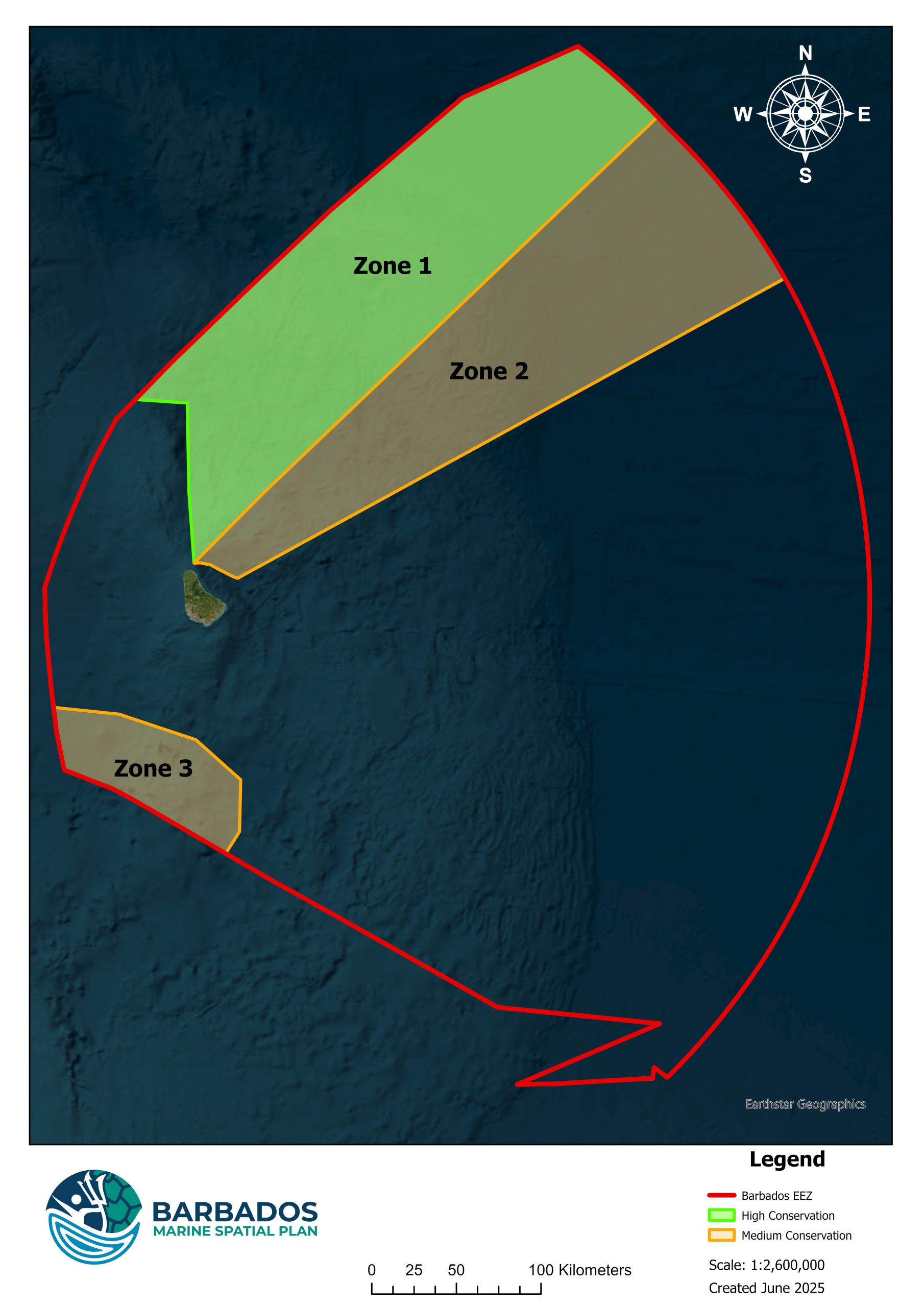
“Calm Seas” presents a balanced approach to marine conservation offering 31.46% protection almost evenly distributed between High Biodiversity Protection and Medium Biodiversity protection with an emphasis on flexibility in high-use nearshore areas and along major offshore transit routes.
We are currently in the process of translating stakeholder feedback and sector-specific insights into a final marine management plan. Early designs for an integrated conservation scenario are now under development. Our goal is to move beyond these initial options to create a final, widely supported framework that secures Barbados' marine future for generations to come.
Click here to view the scenarios in detail and submit your feedback to